
Christopher Nolan and Hoyte van Hoytema They form a cinematographic team like few others, due to their hyper-attention to realism, even in their epic version of . “It’s definitely cinema in its purest form,” he says. van Hoytemathe Dutch cinematographer who has worked with Nolan since (2014). “He loves trying new things he hasn’t done before, and so do I. We like to spend a lot of time in real places, in real locations, having things in front of the camera that are tangible and tactile.”
For the first commercial feature film shot entirely with bulky IMAX cameras, that meant shooting across oceans and deserts, in three-minute bursts. Although Nolan He often points out that three of his films have won Oscars for visual effects, many of his techniques would be familiar to directors of a century ago; others were cutting-edge inventions created just for him.
We talked to him about his ethics and anxiety around the film. In separate interviews, he and van Hoytema They talked about their approach and why they don’t like to plan everything. These are edited excerpts from those conversations.
—Why was it so important for you to use IMAX, despite all these technical challenges?
CHRISTOPHER NOLAN: I originally saw IMAX movies in museums and theme parks as a kid and immediately thought, why don’t they make movies like that? That was when I was 16 or 17 years old. Now I’m about to turn 56, and I’ve finally managed to do it.
I have been using the format for almost 20 years. We started just with the action sequences: you’re climbing a mountain with a camera, sailing the seas and all that. Then we tried to incorporate it over the years into more intimate scenes. But what made it most difficult was the sound, because the cameras are very, very loud.
HOYTE VAN HOYTEMA: It sounds like a lawn mowera diesel engine.
NOLAN: After (2023), I called my friends at IMAX. I couldn’t tell them yet what the movie was about, but I told them that if we were ever going to make an all-IMAX movie, this would have to be it. So let’s finish these new chambers, let’s find some kind of soundproofing system. And they designed this zeppelin-like system that we could put the camera on.
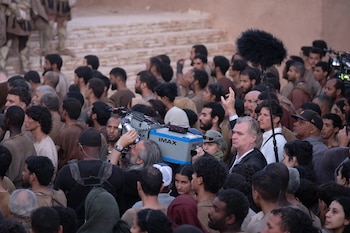
VAN HOYTEMA: A year before production, we were presented with three different prototypes. With the zeppelin you can’t hear anything, just a small, distant purr. But to filter the sound, it had to be heavy, which brought a whole new set of problems to solve. We ended up with a very clunky box, almost the size of an SUV. We were determined to make it work.
We did it with pure brute force, holding it on tripods, or carrying it up and down hills. Sometimes we took the camera [con cuerda] with helicopter to reach specific places. But these are practical problems that you can solve with mechanics and machines. I like these challenges.
NOLAN: Every shot in those scenes [con mucho diálogo] It was a question of engineering, because you can’t put a 400-pound camera on top of an actor. You have to assemble chain hoists, find a way to move the camera properly. Everything must be done safely. And there were many unknowns, because you can only load three minutes of film. I had to find a rhythm between my crew, my actors and myself to break the shot, reload the camera and keep everyone focused.
The tradition with “action” and “cut”: there is an incredible concentration between those two words. Once you say cut, everyone breathes a sigh of relief; the tension disappears. What we have to do is keep everyone under that spell. The first camera assistant, Keith Davisdiscovered how to recharge the camera incredibly quickly and silently. He reduced it to less than two minutes. When we first worked with IMAX in 2007, they warned us that a recharge took 25 minutes.
VAN HOYTEMA: When we started doing it, I heard the myth about the IMAX camera, the size and how difficult it was. We decided: why don’t we try it? I like filmmakers to understand: Try.
[En ]I operated 90 percent of the film. The IMAX camera without the zeppelin does not weigh 45 kilos. Not even half, you know? And someone puts it on my shoulder. I’m not carrying it all day.
Now I have worked with the same people so many times, who know the weight and how to secure it. My , Kyle Cardenis like a dancer; It is strong and powerful but also very sensitive. The zeppelin, when I tilt down, becomes so top-heavy that it would throw me off. Kyle counterbalances it.
Ryan Monroemy other assistant; It’s almost as if we were a two-headed monster, always tangled. On the waves, when I lean, he reaches out with an arm and counterbalances me. He described it as two men playing Twister, fighting with a sewing machine. It’s funny to watch but very effective.
—You use a lot of practical effects. To do it in a film of such scale is quite an achievement. Why do it? It’s not cheaper, right?
NOLAN: Many times it is. when we did (2020) and was looking at how to stage a 747 crashing into a building, economically it made more sense to buy a plane, build a building and crash it, and then sell the plane for scrap.
You’re actually looking to maintain tonal consistency, photographically. Going on a real ship on a real ocean and filming the actors in that environment puts a pretty big demand on the visual effects. My visual effects advisor, Andrew Jacksonwas finding real solutions as we moved forward.
In We use all the techniques in the book: paints, painted backgrounds. They can create a much more convincing illusion—because of how you can light them—than having a green screen or even a photographic background. We also used a lot of false perspective illusions, where you build smaller things in the far background. In I remember seeing that beautiful painted background; There is a river and sparkles in the rippling waters. How the hell? You realize that they have put fishing lines with pieces of aluminum foil and a fan blowing. That gives it a sparkle similar to that of water. It’s those old tricks that fool the eye, the camera.
VAN HOYTEMA: We watch the viewings every day, all together. So whether you use CG or not depends a lot on what you already have filmed.
[Grabando en IMAX]our whole process is analogical. When you use a digital effect, you have to scan your original negative and reduce the resolution to do it. Then you film it again at a reduced resolution. There is a whole step where you can lose a lot of quality. The more we keep in camera, the more we maintain that original quality. That has always been very important to us.
—Do they make storyboards?
NOLAN: I don’t usually think in pictorial terms, in general. I prefer to discover it in the process; That’s part of the fun. Over the years I have made less and less storyboards. I make them for department heads if we have a complex action sequence. Hoyte has been an absolute master at saying: “We are going to film the fall of Troy, with thousands of extras, things that we are going to set on fire,” but he knows that I want to arrive at night and improvise.
VAN HOYTEMA: With Chris, you want to find yourself somewhere you haven’t really been before, understand the energy and channel it to communicate it in the best way. Drawings made months before in an office will never represent that.
I love that we get out of our cars in the morning, get to the set and see what the weather is like, how the actors are doing. sometimes things [como decorados] They collapse during the night. Interesting things happen. You never know what the sea will do. One day it can be very windy and another, you can film on a mirror. We had an amazing marine department keeping a close eye on the tides. We had a special meteorologist.
But the truth is, you can only predict so much. AND we don’t want to predict everythingYou know? If not, you could film everything in a studio. You want to welcome the ends of the world with open arms.
—They also invented a new lighting system.
VAN HOYTEMA: For 95 percent of the movie, the nights are illuminated only by lights we built ourselves. we call them . It is an invented word, because of the shape: pyramids of fire.
When Chris and I talked about the movie at the beginning and watched a lot of movies for reference, I started to get annoyed by the big battles. They are traditionally lit with moon boxes: giant frames above the scene that contain lights and simulate soft moonlight. I always noticed the artificial lighting. So the initial idea was to want illuminate everything with fire. I wanted the camera to see what the human eye would see.
Of course, you quickly realize that it is very impractical. Because: A) The fire gives very little light, so you would have to light a lot. YB) Every time you light a fire, instead of extras you need special effects technicians and a firefighter with a fire extinguisher. So I went back to the drawing board: could I make a firework that we would bring to the set and light? We started testing and working with an LED company.
We opened an entire production facility to manufacture these lights, with custom-made components, some existing electronics, others we created. We had 1,000 1.22 meter panels; We could literally hide them in any corner. They were designed to give that authentic flicker, based on real flames. We had different settings for stormy or calm weather. You just had to place them and you could see the fire 1.6 kilometers away, illuminating the trees. It was a revelation for me to work like this at night. It gave us a lot of freedom.
NOLAN: That’s what I love: putting all the elements in place so that we can experience something and for the actors to experience something, and letting that guide the photography. Trying to create a world, and then live in it.
Source: Infobae

