
“One small step for man, one giant step for humanity” is one of the phrases etched in history from the moment Neil Armstrong set foot on the Moon.
The Apollo missions not only took astronauts to space but brought back 382 kilos of rocks, left instruments that remain operational half a century later, and forced the development of technologies that ended up reconfiguring life on this planet.
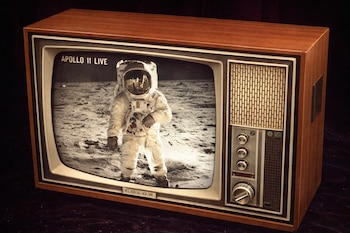
On this key date – always surrounded by controversy about whether it actually happened after its television broadcast! – there are five specific learnings that continue to surprise today.

The moon was born from a cosmic collision
Before 1969 there were at least three hypotheses about the origin of the Earth’s satellite. Some proposed that it had been captured by the Earth’s gravity, others that it had become detached from a rapidly rotating Earth (fission hypothesis), or that it had formed next to our planet from the same primitive debris (simultaneous accretion).
The lack of physical data only further fueled the rivalry between the different hypotheses. But samples of rock and regolith (dust and loose material) from the Apollo 11 mission made it possible to analyze that the Moon had gone through a state of global fusion and that it contained unusually high levels of potassium, rare earths and phosphorus, elements known as KREEP, which can only be explained if the satellite was completely molten at some point in its history.
This discovery tipped the balance towards the great impact theory, in which it was proposed that the Moon would have formed after a body the size of Mars, which scientists named Theia, collided with a still young and partially molten Earth. The fragments ejected by that colossal collision would have ended up condensing into the satellite we see today.
A chronometer for the solar system
Unlike on Earth, where geological activity, erosion and plate tectonics erase or recycle the record of older rocks, the lunar surface has remained virtually frozen in time for billions of years.
That turned the rock samples from the Apollo mission into a kind of time capsule that allowed them to be dated with radiometric methods; measuring the decay of isotopes of elements such as uranium, lead, potassium and argon. For example, the age of the Moon was determined to be 4.5 billion years.
In this way, scientists were able to gauge the age of the solar system much more precisely and reconstruct the chronology of the large asteroid bombardments that also hit Earth.

Mirrors that dialogue with the Earth
On each of the Apollo 11, 14, and 15 missions, astronauts left a laser retroreflector on the lunar surface; a set of prisms capable of returning a beam of light exactly in the direction from which it came, regardless of the angle at which it arrives.
Since then, various ground-based observatories have fired laser pulses at these mirrors and measured the time it takes for the light to return. The result is the technique known as Lunar Laser Ranging, which allows the distance between the Earth and the Moon to be calculated with a margin of error of just a few centimeters over an average distance of 384,400 kilometers.
This experiment, active uninterruptedly for more than five decades, is today the longest-lived scientific instrument that humanity left outside the planet. Thanks to it, it was confirmed that the Moon is moving away from the Earth at a rate of about 3.8 centimeters per year. Furthermore, from this dialogue of light, additional evidence was obtained in favor of Einstein’s theory of general relativity and models of geodesy and navigation were perfected.

The chip revolution
Reaching the Moon impacted the technological development race. A computer capable of making complex navigation calculations, but at the same time light, was needed to fit into a capsule.
Apollo Guidance Computer (AGC) was designed at MIT under the direction of Charles Stark Draper, with Margaret Hamilton leading the software development, it was the first computer in history built massively with integrated circuits, the predecessors of today’s microchips.
Around one million of these chips were used for the entire Apollo program, a figure that at the time represented close to 60% of all integrated circuit production capacity in the United States. This demand then led to the cost of its manufacturing being lowered; an opportunity that was capitalized on for the development of personal computing and cell phones.
The “spin-off” of the moon landing
Since 1976, NASA has been documenting, in its annual Spinoff publication, the commercial products and processes derived from the technologies developed to reach the Moon.
Among the most cited examples are reflective thermal blankets that are now used in marathons and medical emergencies. A development originally thought to insulate astronauts from the extreme cold of space.
Water purification systems with silver ions also stand out, which were later applied to pools and community drinking water systems; the fluid filtration processes developed to eliminate toxic waste, which ended up being adapted to kidney dialysis machines; and the miniaturized sensors that the agency promoted for space cameras, a direct antecedent of the CMOS sensors that cell phone cameras carry today. In addition to fire-resistant materials used in firefighter suits and thermal insulation technologies that are now part of building construction.
With the Artemis program underway, that scientific legacy of the Apollo missions is the starting point for the next generation of instruments that will return to the lunar surface.
Source: Infobae

